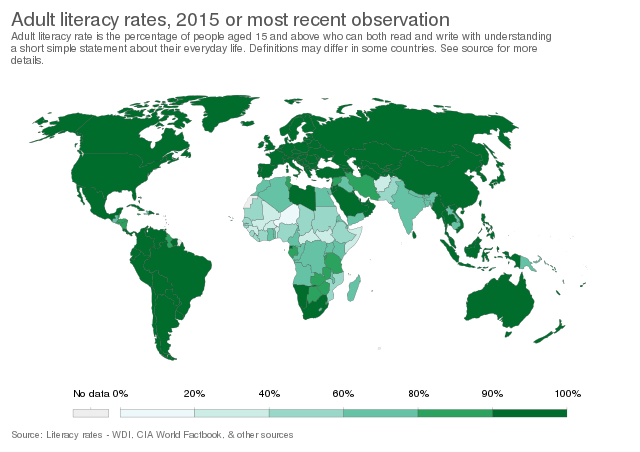
In Canada, we have effortless access to good education, and we may take that for granted sometimes.
While Canada has a literacy rate of 99%, all while other countries have significantly lower literacy rates. To understand why this is a significant issue, we first must understand what literacy is, or more specifically, what illiteracy is.
UNESCO defined illiteracy, or rather Functional Illiteracy, as someone who “cannot with understanding both read and write a short simple statement on his everyday life”, and “A person is functionally illiterate who cannot engage in all those activities in which literacy is required for effective functioning of his group and community and also for enabling him to continue to use reading, writing and calculation for his own and the community’s development.”
Being below the poverty line and having poor literacy are two things that commonly go hand in hand, which is easy to see in the United States, where 43% of illiterate adults lived below the poverty line. Having literacy in a country is an important step in having a healthy, diverse economy.
Illiteracy may be caused in a variety of ways, such as being located in an impoverished area with inaccessible or inadequate schooling, living in an area or country where education is denied to certain citizens, etc.
An example of inaccesible or inadequate schooling would be rural India, as despite the government’s efforts, attendance is low and the schools are poorly funded and staffed. On top of being poorly run, Indian farms also require as many hands as possible, as they are barely able to pay for their living. It is because of these conditions that only 18% of Indian boys and 10% of Indian girls earn their high school diploma.